
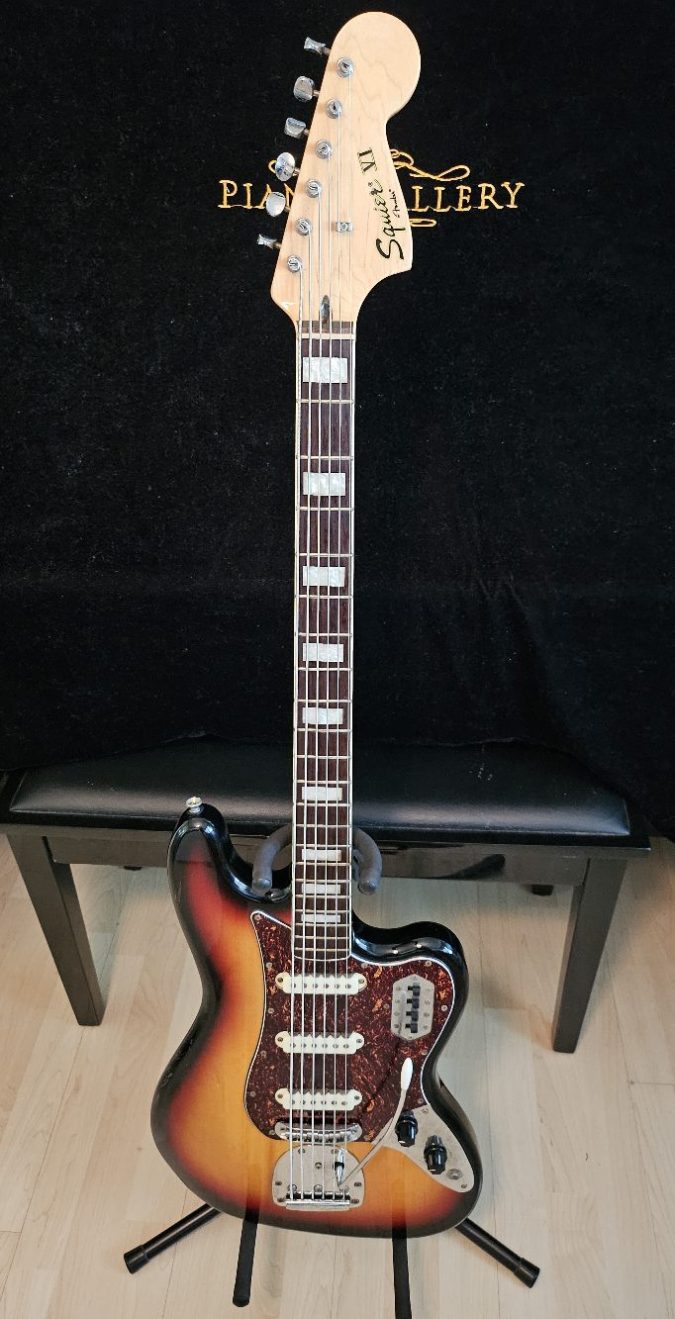
For the last few days, I set aside my usual guitars — Red and Spring — to give my rescued Squier Vintage Modified Bass VI a fair shot at proving herself. I’ve had one Bass VI (Squier Class Vibe) before, and honestly, that one often resisted me. This one came with scars, abuse, and neglect, and I was cautiously optimistic.
Phase One: Trial and Error (on Emerald Room)
I started with Secret Path on, leaving both the Russian Muff and Team Medic off. The Bass VI sounded… uninspiring. Solid as a bass, yes. But when I played her like a guitar, the notes felt flat, lacking context and voice. Turning on Team Medic with Secret Path still engaged added some control, but the spark was missing.
Then I tried Secret Path off, Team Medic only. Better, but still not enough to wow me. Something was still missing.
Phase Two: The Magic Combination
I finally tried Russian Muff + Team Medic with Secret Path off. And then it happened. The Bass VI came alive. The Team Medic tamed the fuzz, while the Russian Muff added sustain and musical context. Suddenly, I could run melodic lines in A major and D major, slow, unhurried, and expressive. Each note had presence, and the interplay between sustain and control allowed the instrument to sing.
Interestingly, I discovered that Russian Muff alone could also unlock her melodic voice — just fuzzy, but controllable, especially with slow fingered playing on bass strings. No reverb needed. The Bass VI now feels teachable and responsive, ready to follow my lead, rather than resisting.
Phase Three: The Takeaway
This experiment reaffirmed something I’ve always believed: gear is a servant, not a master. With patience and careful exploration of signal chains, even a “difficult” instrument can reveal a voice you never knew it had. The rescued Bass VI may not yet be my go-to instrument, but she’s earned a spot in my arsenal.
Sometimes, the joy isn’t just in finding an instrument you love immediately — it’s in unlocking one that teaches you new ways to play.