
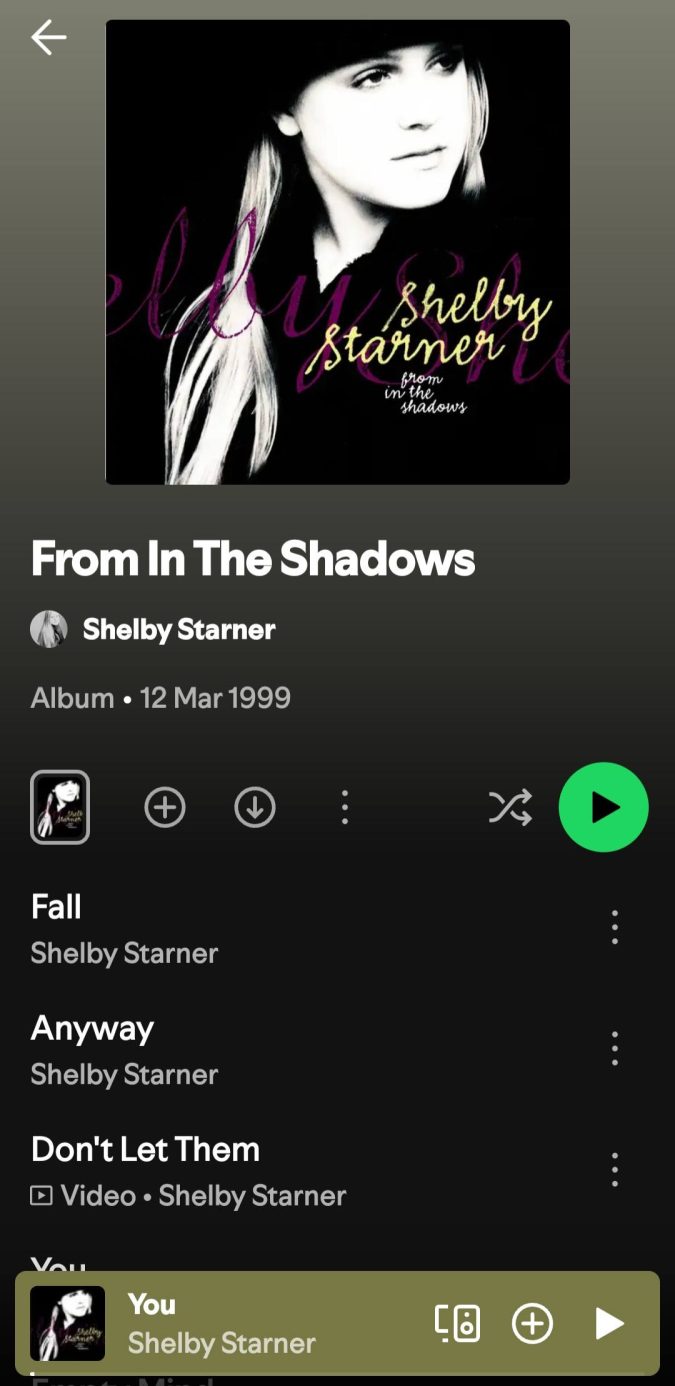
I bought From in the Shadows the year it was released.
I didn’t discover Shelby Starner through radio, hype, or word of mouth. I found the album the old way — through a review in a local music magazine. I can’t remember who wrote it now, or exactly how the review was framed. I only remember that it intrigued me enough to act on it.
So I went down to Tower Records — back when it still existed.
I listened to the album there, standing with the headphones on, moving through the tracks without rushing. No algorithm. No recommendations. Just time and attention. Somewhere during that listen, I remember thinking very clearly: okay, gotta buy it.
And that was that.
Even then, From in the Shadows didn’t feel like a label-crafted debut or a teenage project engineered for quick impact. It felt inward. Honest. Unassuming. Shelby’s songs carried emotional weight without dramatics. Her lyrics didn’t posture. Her voice didn’t oversell. There was restraint everywhere — and confidence in that restraint.
I was impressed. More than that, I was rooting for her.
What’s remarkable — and only becomes more so with time — is that Shelby was just 15 years old when the album was released. Fifteen. An age when most people are still exaggerating feelings, still learning to separate emotion from performance. Yet her songwriting showed clarity, self-awareness, and emotional boundaries that many adults never quite develop.
Songs like “You” aren’t powerful because they are poetic or clever. They are powerful because they are clear-eyed. There’s no begging, no fantasy, no dramatic collapse — just the painful recognition of not being chosen, and the quiet dignity of stepping away. That level of emotional honesty, especially at that age, is extraordinary.
At the time, the album sounded like a beginning. Like the first chapter of a voice that would deepen and evolve with life experience. You could hear an artist still forming — someone learning how to hold emotion without hiding behind volume or ornamentation. It felt natural to assume there would be more to come.
Years later, learning what happened to Shelby was genuinely heartbreaking.
She passed away before she even reached twenty.
Not in a sensational, headline-driven way, but quietly — and with that came the real loss. Not just of a life, but of an artistic journey that would never continue. There would be no second chapter. No evolution. No chance to hear how her songwriting might have matured with time, love, disappointment, or resilience.
Now, as a parent of two girls, that knowledge lands very differently.
I no longer hear the album only as a listener who once rooted for a young artist. I hear it as a father, aware of how young she truly was. A child, articulating pain with adult clarity. Someone’s daughter, navigating emotions she should never have had to carry so early — and carrying them with startling composure.
What hurts most isn’t only the tragedy itself. It’s the unfinished story.
Shelby Starner didn’t disappear because she lacked talent or relevance. She didn’t burn out after shining too brightly. She vanished softly, and the world moved on before fully realising what it had lost. That kind of ending offers no closure — only a gentle ache that resurfaces when a familiar song plays during a commute.
I still listen to From in the Shadows. And it still holds up.
There’s something uniquely powerful about artists who leave behind just one body of work. Their music doesn’t age through reinvention; it ages with us. We bring our own years, our own perspective, our own responsibilities back to the same songs, and they meet us there — unchanged, patient, waiting.
Shelby never became “established” in the way the industry measures success. But she left something far more enduring: songs that speak quietly, truthfully, and without artifice. Songs that don’t shout to be remembered.
Looking back, I’m grateful I found her the way I did — through curiosity, presence, and a moment of stillness in a record store that no longer exists.
Some artists don’t need long careers to matter.
They just need one moment of honesty, captured well.
Shelby Starner gave us that.
And I’m glad I was listening when she did