
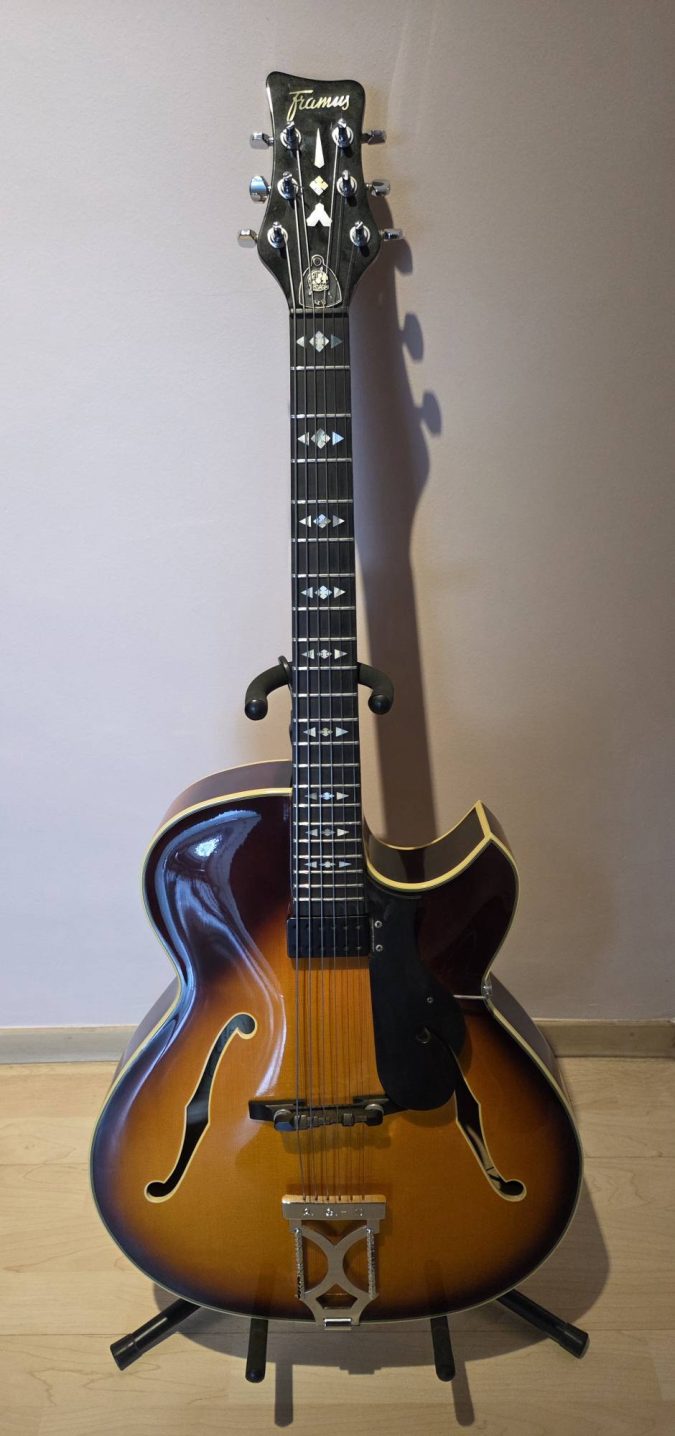
The behemoth arrived today while the Haruna tele and Kotzen strat go the other way.
My first proper session with the Framus AZ-10 Custom was a mixed one.
I cleaned her up but left the existing flatwound strings alone. They came with the guitar and look old. They also feel tight under the fingers, so I don’t yet know how much of that resistance comes from the strings, the gauge, the action, or simply the nature of the guitar. Interestingly, I actually enjoyed having to work a little harder.
I first plugged her into the Laney Cub8 on the balcony.
Not very inspiring.
The weather was hot, and perhaps the environment wasn’t helping. I wasn’t going to judge her from that session.
Then I brought her into the bedroom, where the Fender Pro Junior IV lives.
That was a completely different story.
I put the AZ-10 through the Third Man Hardware Triple Threat, with the echo and overdrive/distortion engaged, all three controls around noon.
And I rocked.
Not metal. Just rock.
The AZ-10 came alive.
Then I discovered something I had never really done with any of my previous hollowbodies or semi-hollows: I deliberately used the feedback.
I sat close to the Pro Junior and let the AZ-10 sustain. At the end of a riff, instead of palm-muting, I simply let the strings ring and allowed the guitar to feed back.
The sustain went on for more than a minute.
I moved the guitar around, changing her position relative to the amp, and found different feedback tones. It became a conversation between guitar, amplifier and room.
Eventually I turned off the Triple Threat’s distortion and palm-muted the strings.
That was probably the moment the AZ-10 really introduced herself.
Her current pickup is a Kent Armstrong Handmade USA Handwound PAF, resin-cast, 12-pole side-mount. The original MEC pickup is in the user kit. I haven’t heard the MEC in this guitar yet, and I’m not rushing to change anything.
The current flatwounds are also an unknown variable. If I keep her, I want to have the guitar properly assessed and probably lower the middle bridge saddle slightly if appropriate, then put on a fresh set of strings.
There was another surprise.
The COA and warranty card that came with the AZ-10 did not belong to her. They were for another Framus guitar.
The original owner explained what had happened: the shop that sold him the AZ-10 had mistakenly given the correct paperwork to a previous customer who became uncontactable. The shop subsequently gave him a discount and a shop warranty. He had also previously received confirmation from Framus that the guitar was authentic, although that old email was gone.
The owner was completely open to reversing the trade and returning my Kotzen Strat and Spring.
I didn’t want to reverse it.
I told the seller that I wanted to hold the trade while I contacted Framus because I liked the guitar and wanted to make sure she was trackable.
So I emailed Framus.
I wasn’t expecting an answer quickly.
It was Saturday afternoon, 15 August. I certainly wasn’t expecting anyone from Warwick/Framus to be sitting around answering a serial-number query on a weekend.
Then someone replied.
And not just someone.
H.P. Wilfer himself.
The leader of the Framus/Warwick story.
Hans-Peter Wilfer founded Warwick and was responsible for bringing the Framus name back under the Warwick umbrella. And here he was, replying personally to my little AZ-10 authenticity query.
His answer was wonderfully simple:
“yes it is an original Framus AZ 10.. what wonderful instrument.”
I did not see that coming.
Framus’ own serial-number finder confirmed the details:
Serial number: J 151622 09
Article number: 1166M16814CPSFHFZLE
Produced: 18 September 2009
Description: AZ 10 Custom, 6-string
Factory finish: Vintage Sunburst
Body: Flamed Maple / AA Spruce top
Neck: Flamed Maple
Hardware: Chrome
Pickguard: Ebony
Made in Germany
So the most important question has been answered.
She is the real thing.
The paperwork is still mismatched, but the guitar herself has now been confirmed directly by Framus and is recorded in their own serial-number system. I will keep H.P. Wilfer’s email and the serial-number record with the AZ-10’s documentation.
And strangely enough, the documentation drama wasn’t the most memorable part of the first day.
The memorable part was standing in the bedroom with the Pro Junior, pushing the Triple Threat, and discovering that this big old German archtop could rock.
I have owned hollowbodies and semi-hollows before.
I never played with their feedback like this.
The AZ-10 made me want to.
That’s enough for a first day.
I don’t need to decide her role yet.
Fresh strings eventually. Proper setup. More playing.
And more of that feedback.
The behemoth has arrived.
And, rather unexpectedly, Framus itself has welcomed her home.