For the longest time, Dorcas was a place of possibilities.
Pedals came and went. Some were bought, some traded, some auditioned, some nearly made the cut. I kept looking for simpler pedals, fewer knobs, cleaner solutions and better ways of doing the same jobs.
Eventually, ‘less is more’ ruled.
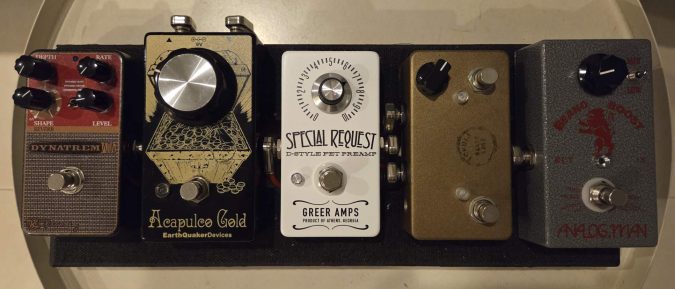
My new-look Dorcas is now:
Beano → Tchula → Special Request → Acapulco Gold → DynaTrem
Five pedals, sitting in a single file on the Ammoon Pedaltrain.
Four of them run on 9V batteries. Only the DynaTrem needs an external power cable.
The Joyo trolley case looks noticeably cleaner without the Mosky MPT-10 and the collection of power wires. There is something satisfying about opening the case and seeing an uncomplicated row of pedals instead of a small electrical installation.
But the real improvement isn’t cosmetic.
The pedals have finally found their jobs.
Beano → Tchula is my lighter gain side. Beano brings her Rangemaster character and pushes the Tchula into edge-of-breakup and overdrive territory.
Special Request → Acapulco Gold is the heavier side. Special Request can boost the AG and, importantly, help tame some of her noise. Together they can cover distortion, overdrive and fuzz.
Then there is DynaTrem, which has turned out to be far more useful than I originally expected. Tremolo, reverb or delay-like ambience—it gives Dorcas her atmospheric side without needing another pedal.
The five-pedal arrangement therefore isn’t really five separate effects.
It is a small system:
Beano → Tchula
edge of breakup and OD
Special Request → AG
OD, distortion and fuzz
DynaTrem
ambience
And there is a useful rule to the whole thing: the two gain pairs work best when they remain separate. Beano and AG together do produce some noise, although it isn’t loud enough to make me abandon the combination. More importantly, the two pairs can coexist happily on the board without turning Dorcas into a noisy mess.
I spent 45 minutes with Lady and Dorcas this evening.
That was enough.
Not because I had explored every possible setting. Quite the opposite. I simply played.
That may be the biggest sign that the consolidation has worked.
There was a time when I was asking whether another one-knob fuzz might be quieter, whether another overdrive might replace three pedals, whether another boost might make Beano redundant, whether another ambience pedal might simplify the board.
All interesting questions.
But at some point, less is more means knowing when to stop removing things.
I like this Dorcas.
So I’m going to leave her alone.
No more searching. No more replacing. No more theoretical improvements.
I’ll play her every day and let the music reveal whether anything is actually wrong.
If a problem eventually appears, I’ll deal with it then.
For now, Dorcas is finished.
And after all the buying, selling, trading, testing, listening and second-guessing, there is something wonderfully simple about that:
I like my pedalboard.
Now I just need to play it.