Dorcas has evolved again.
This is the second time in three weeks.
And this time, the revolution came from one pedal.
When I first built Dorcas, her name had a purpose:
D – Dynamic
O – Omni-platform
R – Resourceful
C – Chameleon
A – Agile
S – Self-contained
She was supposed to be a compact, versatile signal chain that could work across my guitars and amps without becoming a collection of unnecessary options.
For a while, that meant five pedals:
Beano → Tchula → Special Request → Acapulco Gold → DynaTrem
Then the Dope Priest DP-70 arrived.
I already knew I liked her. In fact, I had called her the best dirt pedal I had ever had.
But today, shortly after noon, something clicked.
The DP-70 doesn’t have to live in her native high-gain territory. With Lady’s volume knob and the Special Request working together, I can bring her down into the territory I actually love: clean-ish, edge of breakup, overdrive, distortion and, when I want it, fuzz.
That changed everything.
The three dirt pedals that had only recently arrived—Beano, Tchula and Acapulco Gold—suddenly weren’t necessary on Dorcas.
Not because they are bad pedals.
Quite the opposite.
Beano has her beautiful Rangemaster character. Tchula is a wonderful low-gain voice. Acapulco Gold is gloriously simple and huge.
But one DP-70 was enough.
She could give me the range I wanted, and she could do it while still responding to my hands. With Lady’s volume knob, I wasn’t simply selecting different amounts of gain from a pedal. I was playing the instrument and letting the signal chain respond.
That is much closer to what I have always been looking for.
So Dorcas became:
Special Request → DP-70 → DynaTrem
Three pedals.
Eight knobs.
That’s it.
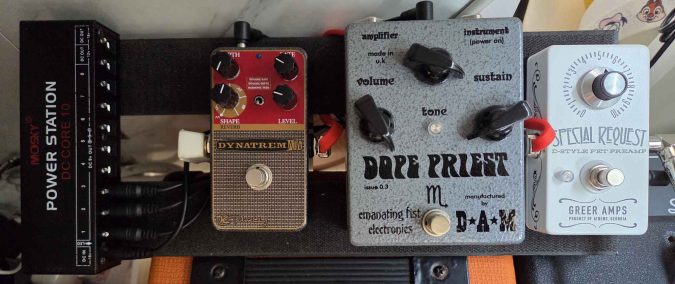
The physical board is just as simple. On the small ammoon Pedaltrain, the Mosky Power Station DC Core 10 now sits at the extreme left, no longer underneath the board, powering the three pedals. Then comes the DynaTrem, the DP-70, and finally the Special Request on the extreme right.
The physical layout is:
DC Core 10 → DynaTrem → DP-70 → Special Request
But the signal runs the other way:
Guitar → Special Request → DP-70 → DynaTrem → amp
The power station can serve ten pedals.
It now serves three.
That seems strangely appropriate.
Dorcas has become almost absurdly efficient.
The three signal pedals each have one clear job.
Special Request shapes and refines the incoming signal.
DP-70 is the heart of the board—the voice that can move from breakup through overdrive and distortion into fuzz.
DynaTrem supplies movement, space, reverb, tremolo, harmonic tremolo, slapback-like ambience, boost and noise control.
Three pedals, but not three compromises.
Three pedals that cover what I actually want to play.
And this is where the name Dorcas still makes sense.
She hasn’t outgrown her original meaning.
If anything, the new three-pedal version fulfils it better.
She is still Dynamic.
Still Omni-platform.
Still Resourceful.
Still Chameleon.
Still Agile.
Still Self-contained.
But I think she has earned a subtitle.
Dorcas — The Triad.
The word fits because this isn’t simply a board with three pedals. It is three parts functioning as one whole.
Shape. Voice. Movement.
And perhaps the biggest lesson is that resourcefulness doesn’t necessarily mean having more options.
Sometimes it means discovering that you need fewer.
The funny thing is that the Beano, Tchula and Acapulco Gold had only just arrived. I had barely had time to enjoy having them.
Then one DP-70 came along and knocked all three out of Dorcas.
They haven’t failed.
They have simply been beaten.
And that’s an important distinction. They can remain individual artists outside Dorcas. But Dorcas doesn’t need to carry every good pedal I own.
She needs to be the signal chain that makes me want to play.
And now she is.
Special Request → DP-70 → DynaTrem
3 pedals. 8 knobs. 1 power station.
My holy grail may have finally become very small.