
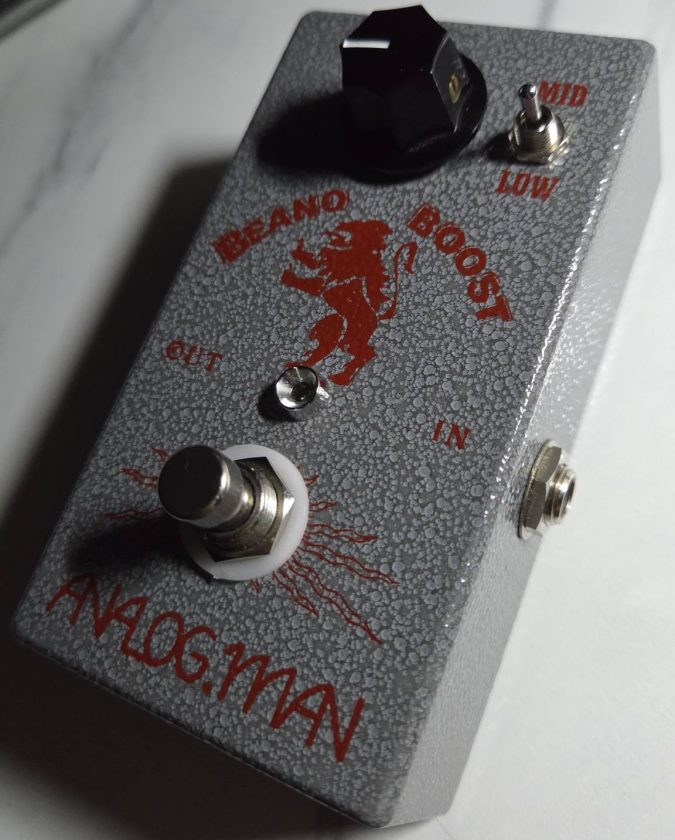
I thought I already understood what the Beano Boost was supposed to do.
After all, Analog Man is quite clear about it: the Beano is a Rangemaster-style germanium booster, and her traditional place is right at the front of the chain. Put her before an amp or another gain stage, push things harder, and let that unmistakable germanium character do her work.
So when Beano joined Dorcas, I naturally put her first.
Then I discovered that my Bender had other ideas.
The experiment
The question was simple enough.
Could I use Beano to manage the Bender’s thick, woolly character?
My Bender already has plenty of gain and fuzz. I wasn’t trying to make her more aggressive. I was wondering whether Beano could tighten things up, add some definition and perhaps give me another useful shade of gain.
I started with Joy, my 1996 American Standard Stratocaster, on the neck pickup.
The setup was:
Joy → Beano → Bender → Secret Path → Guest Gain → Cool Cat Trem → Mimic Mock I → Cub 8
Mimic Mock I was always on.
The moment both Beano and Bender were engaged, the noise became obvious. There was a loud hum with additional hiss. Joy was particularly revealing. I eventually had to turn her tone control almost all the way down before the noise became tolerable.
That wasn’t what I wanted.
I tried Lady next.
Lady was more refined, but the hum and hiss remained.
Then I began eliminating possible causes. I removed the VOX Bulldog from the chain, partly because of her metal chassis. The noise remained.
So the Bulldog wasn’t the culprit.
Then I did the obvious thing.
I swapped Beano and Bender.
Joy/Lady → Bender → Beano → Cub 8
Suddenly, the noise dropped dramatically.
Not completely—these are single-coil guitars, after all—but the remaining hum and hiss sounded like the ordinary background noise I already knew from the Strat and the Tele.
More importantly, I could bring Joy back into the chain, engage both pedals and leave her tone control at full.
That was the moment the relationship became clear.
Bender first. Beano second.
It turned out that I didn’t need Beano to tame Bender.
I needed Bender to speak first.
Then Beano could respond to her.
The difference was surprisingly musical.
With:
Beano → Bender
Beano was hitting the Bender’s input. The combination was noisier and more compressed than I wanted.
With:
Bender → Beano
Bender established the fundamental fuzz and gain character first. Beano then became the second stage—the boost, colour and final push before the rest of Dorcas and the amp.
Instead of trying to make Bender less like Bender, I was letting her remain herself.
Beano simply came afterward and added what she does best.
That suited me much better.
And then I found Analog Man had already been there
The discovery became even more interesting when I looked more closely at Analog Man’s own advice.
Analog Man warns that the Beano should not have a buffered pedal in front of it, because a buffered signal can make the Beano sound thin and trebly.
My Bender isn’t buffered. She’s true bypass.
So Bender → Beano doesn’t violate that principle.
Then I found something even better.
Analog Man’s own Sun Lion uses the order:
Sun Face → Beano Boost
They explain that they chose this order because it is quieter and gives a less subtle, more cutting sound.
That sounded remarkably familiar.
I had independently arrived at:
Bender → Beano
for essentially the same practical reason.
The Bender goes first. The Beano follows.
Suddenly my unconventional pedal order didn’t feel unconventional at all.
What each pedal does now
This has also changed how I think about the two pedals.
Before the experiment, I was thinking:
Beano: boost
Bender: fuzz
Simple enough.
Now I think of them as a little two-stage gain partnership.
Bender is the character.
She supplies the fuzz, the wool, the attitude and the basic gain voice.
Beano is the finisher.
She adds her germanium colour, pushes the signal and gives the Bender’s sound another layer before it reaches the amp.
I don’t have to ask Beano to make Bender behave.
I can let Bender be Bender.
That is a much more satisfying relationship.
Joy made the difference obvious
Lady is generally more refined and forgiving in my setup, but Joy was the real test.
With Beano first, Joy’s single-coil nature became painfully obvious. I was forced to turn her tone almost to zero to keep the noise under control.
With Bender first and Beano second, Joy could stay at full tone.
The remaining hum was simply the familiar sound of a Stratocaster doing Stratocaster things.
That matters to me.
I don’t want to solve a pedalboard problem by taking away the guitar.
If Joy’s neck pickup wants to be bright, open and single-coil-ish, I want to keep that.
So Analog Man’s “first” isn’t my law
Analog Man’s recommendation remains perfectly sensible.
A Rangemaster-style booster traditionally belongs early. Into the right tube amplifier, Beano can push the amp into that beautiful edge-of-breakup territory I love.
I’ve already heard that relationship with my Pro Junior.
But Dorcas is not a textbook Rangemaster setup.
I’m combining Beano with a Bender, feeding a Cub 8 that behaves differently from my Pro Junior. My guitars are single coils. My pedals, power supply and cables are my particular system.
So the final authority is not the diagram in a manual.
It’s what happens when I actually play.
And what happens in my rig is:
Bender → Beano works.
Very well, in fact.
The new benchmark for Dorcas
This discovery changes how I will evaluate future pedals.
I’m still interested in minimalist fuzzes and overdrives. I’m still looking for ways to simplify Dorcas. But any pedal that claims it can replace the Bender now has a much harder job.
It isn’t enough for it to sound good by itself.
It needs to work with Beano.
Preferably in both directions:
candidate → Beano
and
Beano → candidate
But the benchmark is now firmly established:
Bender → Beano
That is the relationship a replacement has to challenge.
For now, I’m not looking to fix something that isn’t broken.
Bender has her place.
Beano has hers.
And somewhere between the two, Dorcas has become a little more like the rig I was actually looking for.