
I’ve tried the “obvious” solutions before.
One of them was the BOSS GE-7. It’s widely praised, affordable, and practically a standard on many boards. On paper, it does the job.
In my setup, it didn’t.
The noise floor was simply too noticeable for me. Once I heard it, I couldn’t unhear it. It wasn’t just a subtle background hiss—it became part of the signal. And for the way I like to hear my tone, that’s a compromise I’m not willing to make.
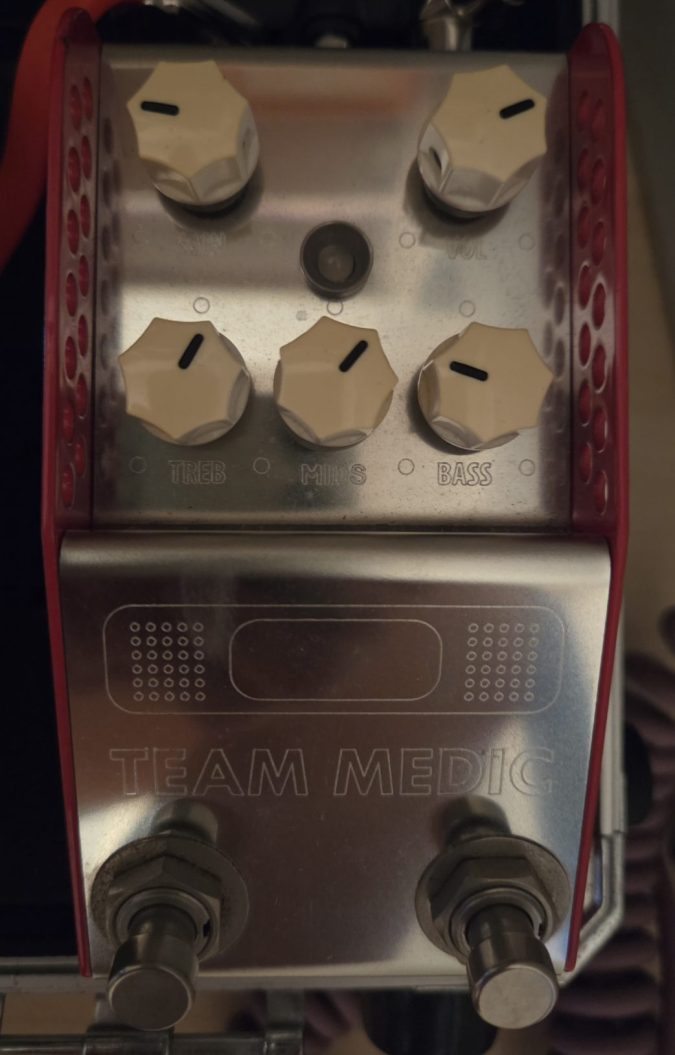
That experience led me to the ThorpyFX Team Medic.
Why the Team Medic stays
At first glance, the Team Medic looks like a utility pedal. Buffer, EQ, boost—nothing flashy.
But in practice, she does something far more important:
she fixes problems without introducing new ones.
That’s the difference that matters.
Noise control without compromise
The first thing that stood out to me was the buffer.
It’s not just there to exist—it actively preserves the integrity of my signal. My board is not small, and I run multiple gain stages, including fuzz. The Team Medic keeps everything coherent without adding audible noise or coloration in bypass.
With the GE-7, I was always aware of the pedal being there.
With the Team Medic:
she disappears when she should.
That’s exactly what a buffer is supposed to do.
EQ that actually feels usable
The active EQ is another key reason she stays.
±6 dB on bass
±6 dB on mids
±6 dB on treble
That may look simple, but the range is musical and controlled. I’m not fighting narrow bands or harsh shifts.
Instead, I can:
tighten low end when things get muddy
bring forward mids for clarity
smooth or open highs depending on the instrument
And importantly:
the adjustments feel like tone shaping, not tone repair.
Boost that earns its place
The boost section is not an afterthought.
clean boost for subtle lift
up to +20 dB for solos or pushing an amp
optional gain for a touch of grit
I can move from unity to emphasis without changing pedals.
That consistency matters when building a repeatable rig.
High headroom, low stress
Internally, the Team Medic operates with significant headroom (±9V split from a 18V system architecture). In practical terms, that means:
it doesn’t collapse under strong pickups
it doesn’t distort when pushed
it stays clean when it needs to
This is especially important in a chain that includes high-output fuzz and gain stages.
Even something as demanding as a Green Russian Big Muff Pi can be brought under control without the EQ or buffer becoming the weak link.
The role she plays in my rig
I don’t think of the Team Medic as an effect.
I think of her as infrastructure.
She:
stabilizes my signal
corrects tonal imbalances
provides gain staging when needed
removes the need for separate EQ and buffer pedals
In a sense, she replaces multiple tools without trying to be them.
Why she stays (and others don’t)
Pedals like the GE-7 solve a problem, but introduce another—noise.
The Team Medic solves multiple problems at once:
buffering without coloration
EQ without harshness
boosting without instability
More importantly:
she does all of this quietly and consistently.
No fuss. No added artifacts. No ongoing trade-offs.
One line that sums it up
I don’t keep the Team Medic because she is exciting—I keep her because she makes everything else work better.
In a rig where every pedal already has a voice, the most valuable addition isn’t another voice.
It’s the one that makes all the others clearer, cleaner, and more usable.