
Most pedalboards are built to do exactly one thing: handle a single electric guitar running into a single amplifier. But if your workflow spans electric guitar, bass, acoustic, and MIDI gear, a rigid, static signal chain simply will not work. You need a modular setup that can adapt on the fly.
By combining a road-worn hard case, an affordable open rail system, and a sentimental birthday gift box from my wife, I engineered a universal mobile workstation on wheels.
Her name is DORCAS—named after the biblical artisan known for her practical, hand-crafted resourcefulness and a name that translates to gazelle (swift, agile, and sure-footed across any terrain).
The Blueprint: D.O.R.C.A.S.
To understand how this ecosystem operates across my home gear setups, you only have to look at her name:
- D – Dynamic (Instantly adapting its role for electric, bass, acoustic, or MIDI)
- O – Omni-platform (A single mobile workspace built to feed any destination or amp)
- R – Resourceful (Crafted with a used shell, flat ribbon cables, and a sentimental gift box)
- C – Chameleon (Effortlessly shifting its tonal identity to blend into any musical environment)
- A – Agile (Sure-footed and rolling smoothly from the bedroom tube setup to the balcony)
- S – Self-contained (Everything wired, isolated, and powered under one secure lid)
Inside the Case: The Spatial Layout
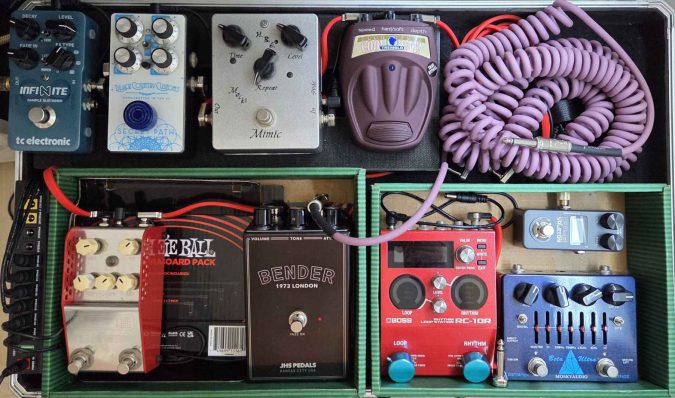
The entire ecosystem is built inside a heavily sticker-bombed Joyo hard case on wheels. Because the case is exceptionally deep, it features an incredible three-dimensional layout split into three distinct zones:
1. The Core 6-Pedal Signal Chain (Lid & Rail)
To maintain a permanent, high-quality audio path, my core six-pedal signal chain is divided seamlessly between the gift box lid and the Ammoon rail deck using ultra-low-profile Ernie Ball flat ribbon patch cables:
- The Front End (The Gift Box Lid): The signal begins inside the lid of my wife’s sentimental birthday gift box. This houses the first two pedals in the chain—the raw, uncompressed JHS Legends of Fuzz Bender (for volume-knob cleanup) running directly into the boutique ThorpyFX Team Medic (acting as a buffer, boost, and active EQ).
- The Atmospheric Deck (The Ammoon Rail): From the Team Medic, the signal jumps over to the fixed Ammoon rail to complete the remaining four pedals of the chain: the Danelectro Cool Cat Tremolo (analog motion) $\rightarrow$ H.B.E. Mimic Mock I (delay tracking) $\rightarrow$ Black Country Customs Secret Path (reverb) $\rightarrow$ TC Electronic Infinite Sample Sustainer (ambient tracking).
2. The Unchained Utility Hub (The Gift Box Base)
Sitting next to the lid is the base of the gift box. This acts as a separate holding bay for my three utility units that sit completely outside the main 6-pedal chain until needed: the BOSS RC-10R Rhythm Loop Station, the Valeton GP-5 Multi-Effects, and the Mosky Beta Ultra Preamp.
3. The Wildcard Floor Bay
Because Dorcas has immense vertical clearance, two heavy-duty Fender cables can be coiled and stacked directly on top of the main pedal deck when closing up. This leaves a dedicated “hot-swap” floor-level bay completely open. It is spacious enough to swallow a massive, tank-like VOX Cooltron Bulldog Distortion for specialized tracking sessions without putting any pressure on the lid.
One Workstation, Multiple Destinations
Instead of cluttering the house with separate rigs, Dorcas serves as the singular brain for everything. The amplifiers are no longer separate stations—they are simply destinations.
- To the Bedroom (The Tube Destination): When it’s time for electric guitar, Dorcas rolls into the bedroom. The signal leverages the entire 6-pedal core chain (from the Bender down to the Infinite) and feeds straight into the organic, raw warmth of a Fender Pro Junior IV tube amp.
- To the Balcony (The High-Fidelity Destination): When switching over to a 5-string active bass or tracking synth and drum loops with a MIDI controller, Dorcas rolls out to the living room balcony. The bass bypasses the guitar chain and plugs directly into the Mosky Beta Ultra resting in the gift box base, sending a pristine line out into the open air via a high-fidelity Phil Jones Bass X4C Nanobass.
Final Thoughts
Building a high-utility rig doesn’t require thousands of dollars in custom boards. By prioritizing an organized signal chain, isolated power via a Mosky MPT-10, and utilizing meaningful, recycled pieces from the past, you can build an incredibly smart ecosystem.
Dorcas proves that with a little resourcefulness, a single $50 case can become a timeless, adaptable, and completely self-contained musical companion.