
There is a distinct, therapeutic peace to an early morning string change. Dusting off the workbench, snipping away the old tension, and laying down a fresh set of light .010s on May, my acoustic—it’s the perfect ritual to start the day. I’ve always preferred the crisp, immediate treble snap of thinner strings over the heavy gauges the previous owner had on her. It just lets the top wood breathe.
But then came the luthier’s curveball.
I spent the next hour trying to mount a passive Seymour Duncan soundhole pickup into May. When I finally plugged her in to test the signal… dead silence. I ran her through the Pro Junior IV, swapped over to the Phil Jones X4C, and even tried the THR10II. Not a single peep. Amps aren’t the issue; it’s a localised mystery inside the pickup housing or the cable shield. A classic workbench frustration. But I went on playing May with new strings a couple of praise and worship songs.
Then, I grabbed Enza, my master-built 5-string short-scale bass and plugged her straight into the power-adapted X4C, and just let the low-end melodies roll out into the open Singapore air. Total mental reset for 10 minutes.
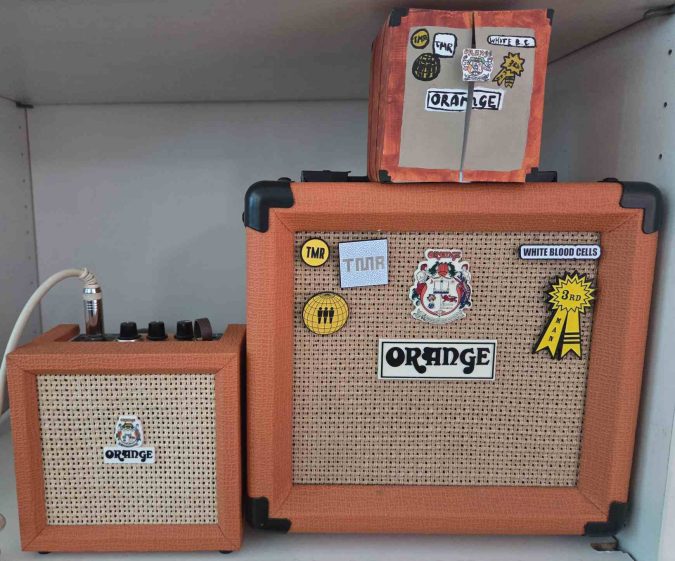
Right after that balcony reset, I found myself staring at my tiny “guest” rig: the Orange Crush Mini plugged into the PPC108 8-inch cabinet.
Yesterday, I plugged Lady (my Telecaster) into her, kicked on my fuzz and overdrive pedals, and was instantly met with a boxy, compressed, muddy honk. Strumming a chord completely blurred the tones. The physics of an 8-inch closed-back speaker simply cannot handle heavy, uncompressed dirt waves.
My immediate guitar-player instinct? Time to upgrade. Maybe a Micro Terror or a Micro Dark head will fix this.
But as I looked at that little stack this morning, I stopped myself. Sitting proudly right on top of the real cabinet is a stunning birthday gift my elder girl made for me last year—a handmade paper-and-ink replica of that exact PPC108. She carefully drew out the frame, the iconic orange color, and even meticulously hand-replicated the tiny metal Third Man Hardware badges I pinned to the real mesh grille.
But the real magic? The paper replica is actually a container. Inside, housed like a secret heart within the cabinet, is a personal, handwritten note she wrote for me that I can open and read whenever I need to. With a trip to Australia coming up very soon to see her, looking at that replica completely re-anchored me.
Selling this Orange stack is completely out of the question. It is an permanent part of our family landscape.
So, instead of pulling out my wallet to force a sentimental, priceless piece of home art to act like a giant stadium stack, I decided to do something different: I played within her limits.
I stopped fighting the box. I mapped out the rules:
- The Dirt Rule: Under high gain, no full chords. I stuck strictly to single-note leads and soaring solos. When wrapped in the ambient wash of delay and the Secret Path reverb, those isolated frequencies transformed. The boxiness vanished, replaced by a beautiful, singing, vocal lead tone.
- The Clean Victory: I stripped the heavy fuzz away, engaged the Team Medic to sculpt the EQ, and tried a pure clean signal. The little speaker suddenly found her headroom. She opened up beautifully, handling full, acoustic-style strumming with a gorgeous, transparent chime.
She sounded so good, so naturally balanced, that I just sat there at the desk right underneath her paper replica, strumming and singing I Speak Jesus by Charity Gayle.
You don’t always need better gear. Sometimes you just need to listen to what the gear is telling you.
By changing my hands to match the physics of the cabinet, the mini-stack instantly became musical. I saved the cute, classic aesthetic of the Orange mini-stack on my desk, honored the incredible hidden words my daughter left for me inside her art, kept my money completely safe in my wallet for my upcoming boutique builds, and walked away with a massive reminder: a true connection to an instrument isn’t bought—it’s learned.