
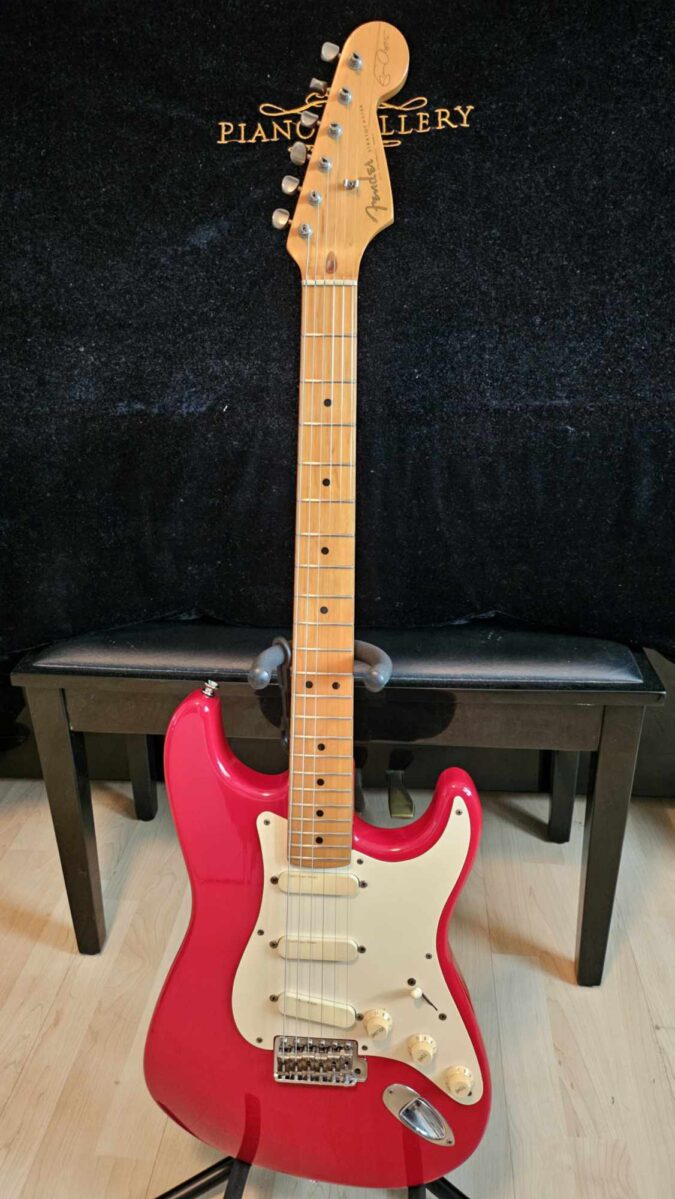
For two years, I thought I knew which Stratocaster I preferred.
The answer was simple: Red.
My 1988 Eric Clapton Stratocaster came from Ishibashi in 2025 for less than two grand. She quickly established herself as the most playable guitar in my collection. Her neck felt right. Her Lace Sensor Gold pickups sounded smooth and refined. She never fought me. She never surprised me. She simply worked.
Over time, Red became my benchmark Stratocaster.
Meanwhile, another Strat sat quietly in the background.
My Fender Custom Shop Empire ’67 Stratocaster, purchased in 2024 for under four grand, was admired mostly through specifications. Roasted alder body. Roasted quarter-sawn maple neck. AAA rosewood fingerboard. Handwound pickups. Vintage appointments. Ron Thorn-signed COA. Magenta sparkle finish.
On paper, she was impressive.
In reality, she never quite displaced Red in my affections.
Until this week.
It started innocently enough.
I woke up one morning intending to fix the blender pot on the Empire ’67. BOL4 was playing through the X4C while I worked. After the repair was done, I moved the music over to my Audio Pro A28 and picked up the guitar.
What happened next was unexpected.
I found myself playing along to To My Youth and later Mermaid. Neck pickup selected. Tone fully open. Volume around seven. Blender bringing in a touch of bridge pickup.
And somewhere in those simple chord progressions, I got goosebumps.
Not because of volume.
Not because of gain.
Not because of a complicated pedal chain.
Just a guitar, a song, and a moment.
I repeated the experience later through the Pro Junior.
The feeling remained.
That was when I realised something uncomfortable.
The Empire ’67 is very close to what I actually want a Stratocaster to be.
If I were to write down my ideal Strat specification today, the list would look something like this:
- Fender Stratocaster
- American made
- Vintage appointments
- Vintage-inspired tones
- Handwound pickups
- Custom Shop grade
- COA signed by a recognised Fender builder
- Cool finish
The funny thing is that I already own that guitar.
The Empire ’67 checks nearly every box.
For two years, I never quite saw it.
Red had taken all my attention.
Now I find myself standing between two very different arguments.
My heart says:
Keep the Empire ’67.
She is the Stratocaster I define.
My head says:
Keep Red.
She is the most playable guitar in the collection, and selling the Empire would free up serious funds for other projects.
The more I think about it, the less this feels like a comparison between two guitars.
It feels like a comparison between two ideas.
Red is the Strat I trust.
The Empire ’67 is the Strat I imagined.
One represents comfort, familiarity and proven reliability.
The other represents a vision I did not realise I already owned.
There is another complication.
If I sold Red, I could probably find another Eric Clapton Strat one day. They are uncommon, but not rare. First-generation examples still appear from time to time.
If I sold the Empire ’67, I could certainly find another Custom Shop Strat. I could even find another vintage-inspired Strat.
But finding another guitar with this exact combination of specifications, character, timing and personal discovery would likely cost more than the money I originally paid.
So for now, I have decided on a simple approach.
The Empire ’67 will remain on the Carousell market.
I will continue to play her.
And I will let the market determine her future.
What I know for certain is this:
A week ago, I thought I knew exactly which Stratocaster would survive in my collection.
Today, I am no longer sure.
And perhaps that uncertainty is telling me something important.