
Last year, I almost bought an octaver.
It was a TC Electronic Nether. I listened to the demos, heard what it could do, and decided quite simply:
I won’t use an octaver.
So I didn’t buy it.
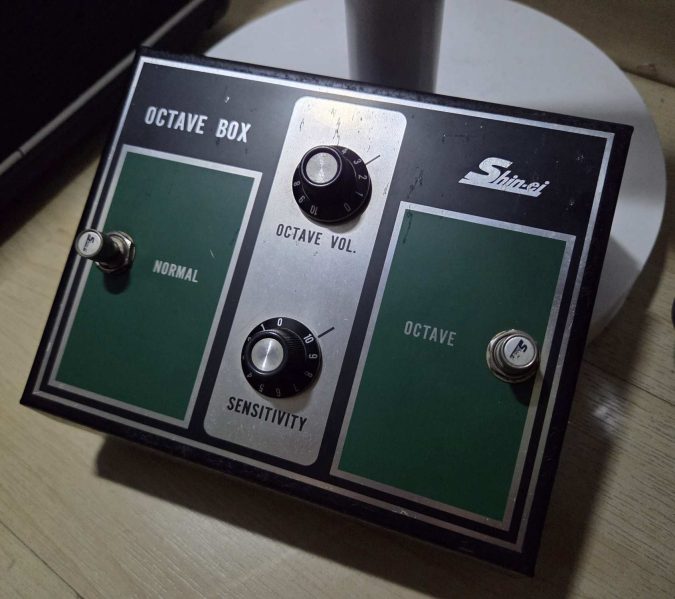
Then, somehow, I ended up bringing home a Shin-Ei OB-28.
I suppose that’s how these things happen.
The first thing I liked about her was that she’s unnecessarily big.
Really big.
There is absolutely no reason a pedal in 2026 needs to occupy this much real estate. Modern pedals can squeeze ridiculous amounts of circuitry into tiny boxes.
The OB-28 doesn’t care.
She’s a big old Japanese box with two green footswitches, a white control strip and two knobs: octave volume and sensitivity.
That’s it.
She’s not trying to be efficient.
She’s not trying to fit neatly into a modern pedalboard.
She’s just big.
And I like that.
I found her at a local used gear shop.
She came with an old Shin-Ei box and period paperwork, including a diagram, warranty material and other Japanese documents. When the shop owner opened her back to put in a 9V battery, we found something even more interesting: a circuit diagram printed inside the pedal.
An old pedal carrying her own map.
One of the documents also contains the date reference 昭和54年, Shōwa 54, which corresponds to 1979, with a mailing period ending 23 March that year.
It doesn’t prove exactly when my particular OB-28 was manufactured, but it gives a useful clue about the period.
For now, I’m happy calling her what she appears to be:
A 1970s Shin-Ei OB-28, with her old box and paperwork.
That’s enough history for me.
Then I actually had to play her.
That was when things became complicated.
My first session was a mess.
I could hear the notes, but the octave seemed to have a mind of her own.
Sometimes she followed.
Sometimes she didn’t.
Sometimes the lower note appeared.
Sometimes it disappeared.
Sometimes she seemed less interested in giving me an octave and more interested in producing some strange harmonic relationship with whatever I was playing.
I couldn’t find the sync.
And, frankly, I didn’t really understand what the two knobs were doing.
I had both of them close to maximum.
That probably didn’t help.
Eventually I started turning things down.
With octave volume around 5 and sensitivity at maximum, something finally happened.
The original note was there.
And underneath it was another note.
An octave lower.
They were moving together.
Not perfectly.
But together.
There was the sync.
For the first time, I could play a simple melody and actually hear what the OB-28 was trying to do.
It was a small victory.
But it felt like I had finally found the door into the pedal.
I kept experimenting.
Eventually she went into the VHT Special 6 with Joy, and I found a setting that made more sense to me: octave volume around 3, sensitivity at 10.
Then I put the Orange Distortion after her.
That combination worked better for me than the higher-gain sounds from the DAM DP-70.
The DP-70 was simply too much.
The OB-28 needed some space to reveal herself.
The Orange Distortion gave me enough boost and gain without swallowing the strange little octave relationship.
And then I noticed something else.
The neck mattered.
Around the middle of the neck, roughly where I would naturally play an A-major barre chord, she could lock onto the notes.
The lower octave would follow.
Move towards the front of the neck and things became less reliable.
Move further up the neck and sometimes the octave wasn’t really an octave anymore.
Instead, she produced something that sounded almost like a strange harmony.
At first I thought something was wrong.
Then I realised that this was the lesson.
The OB-28 wasn’t going to behave like a modern digital octaver where I play a note and receive a predictable octave every time.
She responds to what I give her.
Where I play.
How I attack the note.
How loud the guitar is.
The register.
The sensitivity setting.
What comes before and after her.
Suddenly, “tracking” wasn’t just a specification anymore.
It was something I had to learn with my hands.
That was probably the biggest surprise.
The OB-28 made me play differently.
I had bought plenty of pedals over the years because I wanted something they could give me.
More gain.
More sustain.
More colour.
More movement.
The OB-28 gave me something else.
A problem to solve.
I had to listen more carefully.
I had to find the parts of the neck where she behaved.
I had to change my attack.
I had to adjust.
Then play again.
And again.
That is quite different from buying a sound and switching it on.
It feels more like learning a small instrument.
There was also something strangely appropriate about the music I had playing while driving to the shop and back.
Garbage’s Stupid Girl.
Jack White’s Freedom at 21.
I wasn’t thinking about the OB-28 in those terms at the time, but both songs belong to a world where rough edges and physicality are part of the appeal.
The OB-28 is like that.
She isn’t polished.
She isn’t precise.
She doesn’t always give me the answer I expect.
Sometimes she sounds wrong.
Sometimes she sounds weird.
And sometimes that weirdness is exactly what makes me want to play another note.
The funny thing is, she doesn’t really replace anything.
That’s important to me.
I’ve become much more ruthless with pedals.
If something duplicates another pedal’s job, I don’t really need both.
The OB-28 survives that test easily.
Nobody else in my collection does what she does.
And nobody else does it quite like she does.
I still don’t know how often I’ll use her.
Maybe she’ll become a regular part of my playing.
Maybe she’ll remain an occasional strange sound machine.
Maybe she’ll spend more time being admired than played.
I’m okay with any of those outcomes.
Because I didn’t bring her home because I needed an octaver.
I brought her home because she made me curious.
Last year, I asked myself:
Do I need an octaver?
The answer was no.
With the OB-28, I found myself asking a different question:
What does this thing want me to do?
That’s a much more interesting question.
And maybe that’s why she’s still here.
She’s unnecessarily big.
She’s unnecessarily strange.
She’s completely unnecessary.
But somewhere between the two knobs, the old circuit, the huge box, the wrong notes, the right notes, Joy, the Special 6 and that little moment when everything suddenly locked together—
I found the sync.
And for now, that’s enough.