
There are guitars that arrive and immediately demand a place in your life.
And then there are guitars that arrive, you plug them in, play them for a while, and think:
This is a really good guitar.
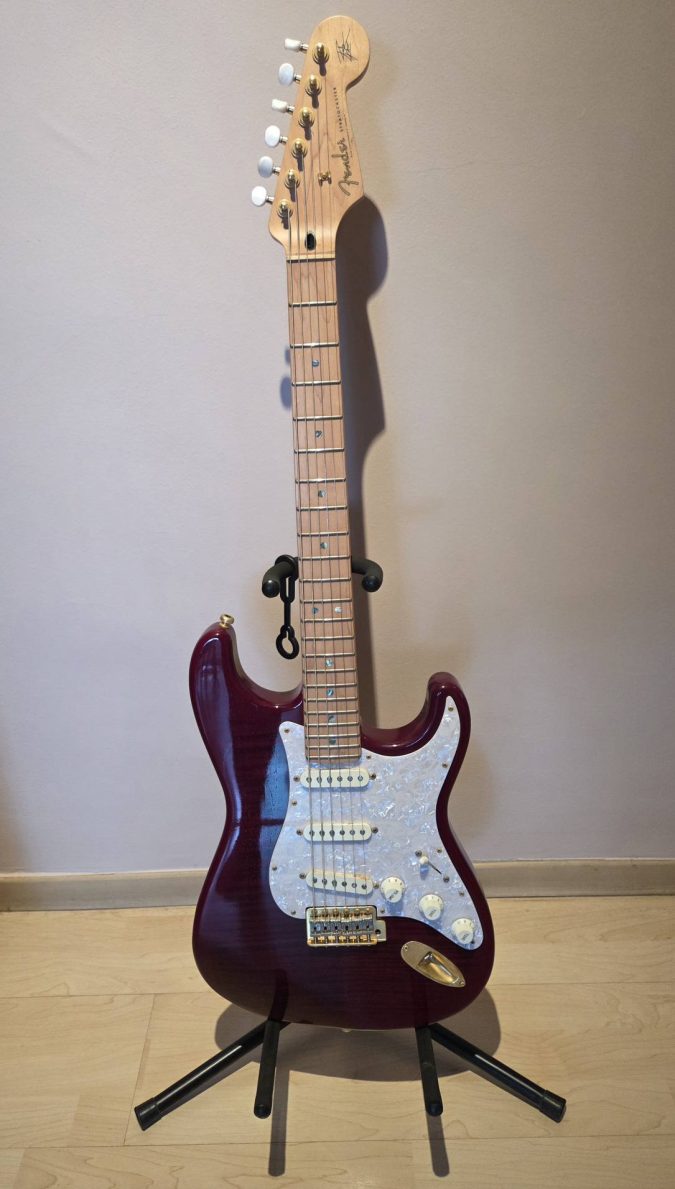
The 2013 Fender Japan Ritchie Kotzen Signature Stratocaster is currently in the second category for me.
She arrived in the family as part of an interesting trade. My 1985 Gibson Les Paul Standard in Alpine White—the guitar I bought for myself in Nagoya as a 50th birthday gift—left my hands, while the Kotzen Strat came home with me together with S$2,400 cash.
I had already made peace with the Les Paul before the trade. I had one last short session with her through DORCAS and the Pro Junior. Fifteen minutes. One word: enjoyable. That was enough. If that was to be our final session together, I was happy with it.
And so the Kotzen arrived.
First impressions
I have now had two short sessions with her: one yesterday and another this morning.
My immediate impression is surprisingly simple:
She’s a darn good Strat.
There is nothing wrong with her. Quite the opposite.
The feel is very familiar to me, particularly because I have spent considerable time with the Fender Custom Shop Empire ’67 Stratocaster. The Kotzen’s substantial neck and overall feel sit in similar territory to my hands. She feels serious without feeling alien.
The pickups, however, are not as hot as the Empire’s.
And that was interesting because the Kotzen Strat is not really a conventional vintage Strat with Ritchie Kotzen’s name put on the headstock. The Japanese model takes the familiar Strat platform and pushes it toward a thicker, more powerful and more performance-oriented instrument.
She has the traditional SSS arrangement, but the construction, neck, fingerboard radius, jumbo frets and DiMarzio pickups give her a more muscular personality.
There is more substance than a typical vintage Strat.
More punch.
More authority.
But strangely, that is also where my ambivalence begins.
She’s good. But does she make me want to play differently?
That is becoming an increasingly important question for me.
In the past, I could easily be seduced by a guitar that was simply excellent. If the neck was good, the pickups were good, the workmanship was good and the guitar looked good, there was a strong temptation to find a reason to keep her.
I’m getting less interested in that now.
My collection has become smaller and more deliberate. I don’t need another guitar merely because it is objectively good.
Lady already occupies the home-Telecaster space.
Red has that effortless playability that makes her almost unfairly easy to live with.
The Empire ’67 is a very capable Strat with hotter pickups and a feel that I already understand.
And Faith, my Pipe Dream Fretworks instrument, is being built specifically to become the ultimate workhorse and the third legacy electric guitar.
So where does the Kotzen fit?
That is the question.
Perhaps she’s simply too close
This is the thing I keep hearing when I play her.
The Kotzen Strat doesn’t sound bad.
She doesn’t feel bad.
She doesn’t lack character.
She just isn’t giving me that feeling of discovery.
And perhaps that is because she is occupying territory I already know.
The Empire ’67 already gives me a substantial Strat experience. The Kotzen is another excellent Strat with its own particular Japanese construction, pickup choices and Ritchie Kotzen-inspired specifications.
But when I switch between them, I’m not thinking:
I need both.
I’m thinking:
Which one would I actually reach for?
That is a very different question.
This is not a criticism of the Kotzen
In fact, I think it is quite the opposite.
She is doing exactly what she was designed to do.
The Kotzen Strat takes the Stratocaster and makes it more substantial. The neck feels good. The larger frets and 12″ radius are comfortable. The instrument has a solid, confident feel. The DiMarzios aren’t screaming at me with excessive output. They give her enough muscle without turning her into some caricature of a metal Strat.
She is a very convincing professional player’s Strat.
And that makes sense.
She served Ritchie Kotzen.
But I am not Ritchie Kotzen.
I am the guy who is perfectly happy plugging a guitar into a Fender Pro Junior, turning things up until the amp starts talking back, and then spending an unreasonable amount of time rolling the guitar’s volume knob back and forth to find the place where clean becomes breakup.
My priorities are slightly different.
I want the guitar and amplifier to have a conversation.
I don’t necessarily need the guitar to have more horsepower.
So I will give her some time
I’m not listing her immediately.
I’ll spend a few more days with the Kotzen Strat.
I’ll play her clean.
I’ll play her through DORCAS.
I’ll use the Pro Junior.
I’ll roll the guitar’s volume back.
I’ll stop trying to evaluate her and simply play.
That last part matters.
Sometimes a guitar that looks ordinary on paper becomes indispensable after a few weeks. Sometimes the opposite happens: the initial excitement wears off and you realise you were admiring the instrument more than actually playing it.
The Kotzen deserves the chance to reveal which one she is.
For now, however, my honest assessment remains:
She’s a darn good Strat.
And increasingly, I’m discovering that “darn good” isn’t necessarily enough anymore.
If, after these next few days, I still don’t feel compelled to keep her, then I’ll list her for sale without much drama.
And that’s not a failure.
The trade has already done something useful.
I said goodbye to a 42-year-old Gibson Les Paul that had been a 50th birthday gift to myself in Nagoya. I welcomed a Japanese Ritchie Kotzen Strat into the family. I received S$2,400 cash that can potentially go toward Joy—or simply remain available for whatever comes next.
I got to spend time with a guitar I might never otherwise have owned.
And I learned something about what I actually want from a Stratocaster.
Sometimes a guitar’s job isn’t to stay.
Sometimes she just needs to arrive, be played, teach you something, and eventually move on.
The Kotzen may turn out to be one of those guitars.
For now, though, she’s still here.
And tomorrow, I’ll plug her in again.