
There are seasons in a musician’s life where the gear doesn’t just move — the mindset moves with it.
On 4 December 2025, I wrote about shifting my setup out of the study and into the master bedroom. What I didn’t realise then was that it wasn’t a downgrade. It was a refinement.
The study became my eldest daughter’s space. The music didn’t disappear. It simply found new rooms to breathe in.
Today, the system feels complete.
In the master bedroom, my core rig rests quietly.
The Fender Pro Junior IV sits hidden in a cabinet alongside the Boss RC-10R and the Bugera PS-1. Doors closed when silence is needed, open when the room is mine again. When I want to play through her, I commit. She’s not background noise—she’s a moment.
Above her, the smaller amps—the Orange pieces, the Yamaha THR10II, and the **Positive Grid Spark Go units—sit like ornaments. Quiet most of the time. Ready when called upon. Not everything needs to shout to matter.
The living room carries a different role.
The essential pedals sit neatly in a Joyo case, alongside two or three family guitars. They don’t just function—they belong. They’re part of the space, not hidden away from it. Music, here, is visible. Accessible. Part of daily life.
Then there is the new addition—the workstation.
What began as a practical purchase for work has quietly become one of the most important musical spaces in the house. Folded down, it serves just the two of us. Opened up, it welcomes six. It sits by the window, never in the way, always ready.
And now, it holds a new voice.
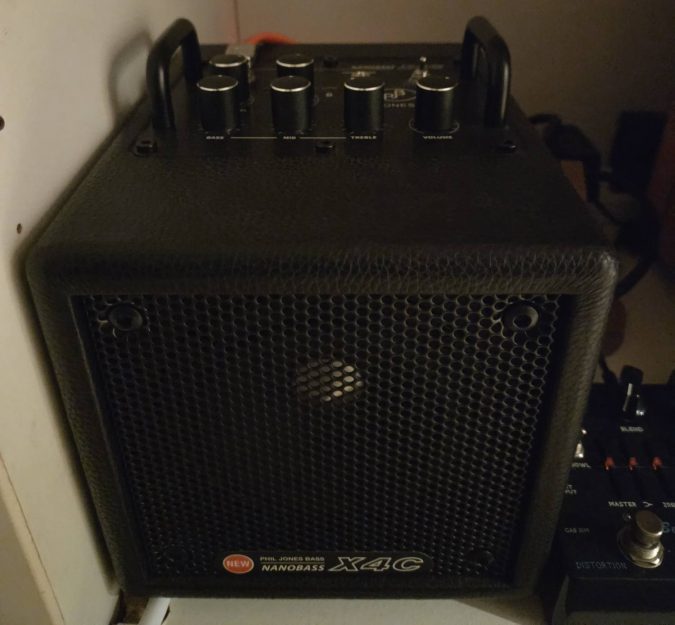
At the bottom shelf, out of sight but always within reach, sits the Phil Jones Bass X4C Nanobass, paired with the Beta Ultra. She is small, almost discreet—but she carries more than her size suggests.
Here, I can pick up Enza, plug in, and play without ceremony.
No setup. No friction.
Just sound.
My DT 770 Pro sits here too. When needed, the world narrows to just the instrument and my ears. And when I want the opposite—when I want music to fill the space—the Nanobass connects effortlessly via Bluetooth. The same speaker that carries my playing carries the music I learn from.
And despite her name, she isn’t limited.
She’s a multi-instrument voice. Bass, guitar, whatever I bring to her—she responds.
So now, I have choices.
I can play through the Pro Junior in the quiet of the master bedroom.
I can sit by the window and let the Nanobass carry the moment.
Or I can go fully portable with the THR10II and the Spark Gos.
None of these setups compete.
They coexist.
This is no longer about building a rig.
It’s about placing the right voice in the right space.
About removing barriers between intention and action.
About letting music live where life already happens.
And perhaps that’s the real shift.
Not from one room to another.
But from having to make time to play
to being able to play whenever time appears.