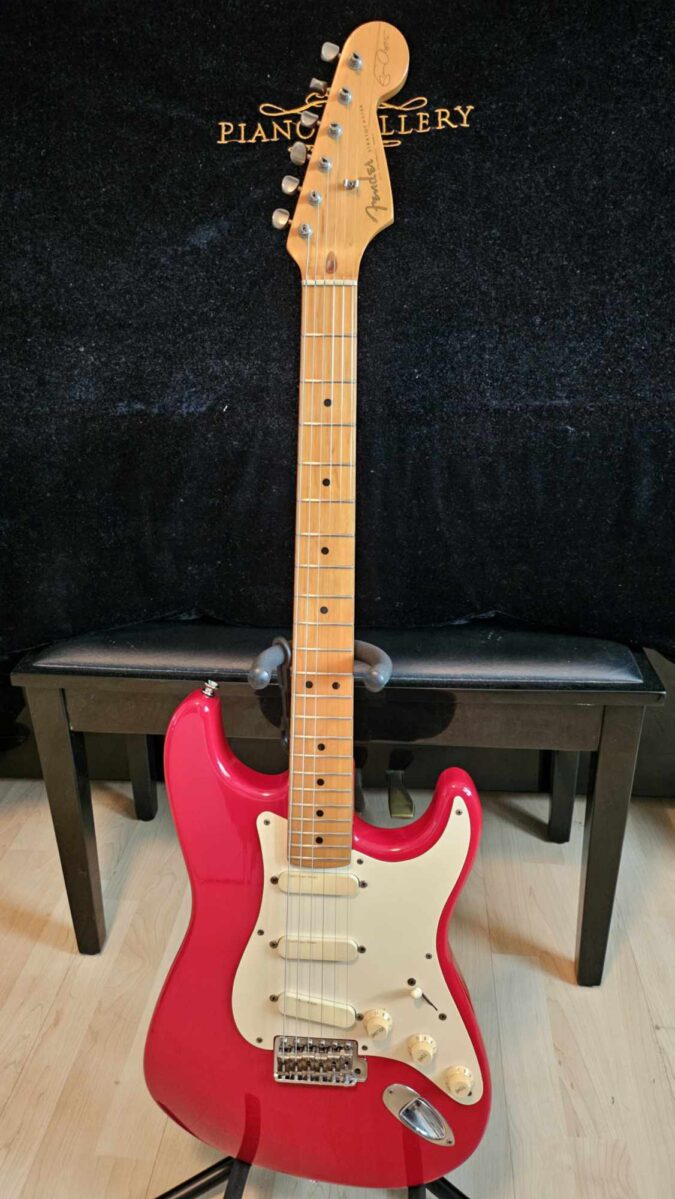
There are guitars that impress you in a shop.
Then there are guitars that stay with you long enough to change how you play.
My 1988 Fender Eric Clapton Stratocaster, “Red,” falls firmly into the second category.
🎯 What makes her different
On paper, she doesn’t scream for attention.
She’s still a Strat:
familiar shape
familiar controls
nothing visually outrageous
But plug her in, and she behaves differently.
There’s a focus to her sound. Notes come out clean, direct, and controlled—especially on the low strings, where many guitars start to lose definition.
She doesn’t sprawl. She speaks.
🎸 The feel under the fingers
Red doesn’t fight you, but she doesn’t flatter you either.
play softly → she stays articulate
dig in → she pushes back with authority
roll the volume → she cleans up without falling apart
There’s a sense that she is:
responding, not just producing sound
That alone separates her from many modern instruments.
🎯 The electronics (where she really separates herself)
Red’s control layout looks simple—but it’s far more powerful than a standard Strat.
She carries:
master volume
master active mid boost (0–25dB)
master TBX tone control
The Lace Sensor pickups give her:
low noise
a smoother top end
a tighter, more controlled low end
But the real character comes from how these controls interact.
🎛️ Mid boost (0–25dB)
This isn’t just “more gain.”
Used properly, she:
thickens single notes
pushes the midrange forward
adds authority without losing clarity
At higher settings, she moves toward:
a humbucker-like voice—but tighter and more controlled
🎛️ TBX tone control
Unlike a normal tone knob:
roll back → behaves like a traditional tone control
push forward → opens up the top end and presence
So instead of just cutting highs, she can:
both tame and enhance your signal
🎯 What this means in practice
With just three controls, Red can move between:
clean, controlled Strat tones
pushed, mid-forward lead tones
tighter, almost humbucker-like drive
All without changing guitars or touching your pedals.
🧠 Why she works in a real rig
Through something honest like a Fender Pro Junior IV, her character becomes obvious:
low strings stay defined under gain
chords don’t collapse into mud
lead lines hold their shape
She doesn’t need help to sound clear. She starts there.
⚠️ What she’s not
She isn’t:
a vintage-correct, glassy Strat
a “quack in positions 2 and 4” machine
a guitar that hides behind sparkle
If that’s what you want, she may not be it.
🎯 What she actually offers
Red gives you:
clarity under drive
controlled low end
midrange presence when you need it
and a consistency that makes you trust her
She’s less about chasing tones, and more about:
getting a usable, musical sound quickly
🧠 The real value
She isn’t a guitar that makes you sound like someone else.
She’s a guitar that:
reveals your phrasing
responds to your touch
and holds together when things get pushed
Over time, you stop thinking about the specs.
You just play her.
One line to close it
Red doesn’t try to impress—she just keeps showing up, clear and reliable, every time you plug in.
That version is tight, accurate, and sounds like it came from someone who actually lives with the instrument—not someone reading a spec sheet.