
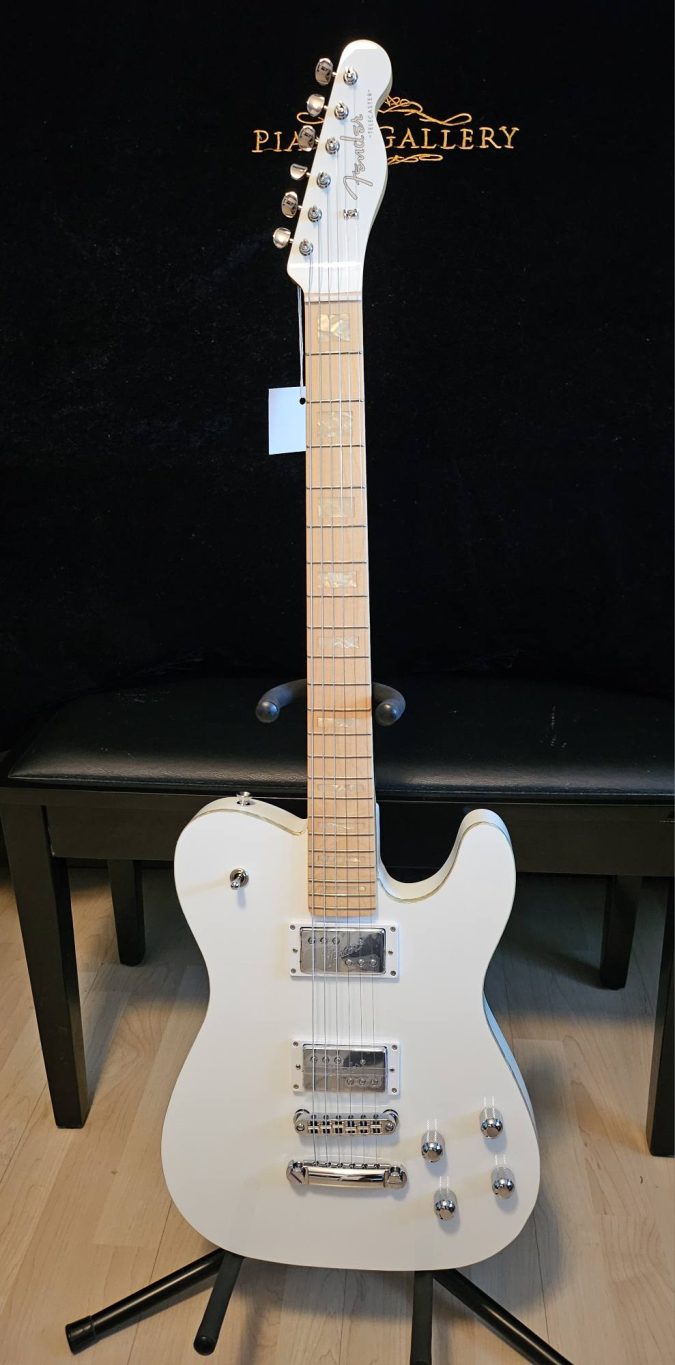
There are Telecasters that follow tradition.
Then there are Telecasters that quietly ignore it—and end up more useful because of it.
My 2023 Fender Haruna Telecaster Boost, “Spring,” is firmly in that second camp.
🎯 What makes her different
At a glance, she looks familiar:
- Telecaster shape
- clean lines
- understated elegance
But that’s where the familiarity ends.
Spring is not built around the usual Tele formula. She’s built to cover ground—from clean passages to driven rock—without changing instruments.
🎸 The foundation: mahogany, not ash or alder
The first shift happens before you even plug in.
- Mahogany body instead of the traditional Tele woods
That changes everything:
- more weight in the low end
- smoother highs
- a thicker, more grounded voice
She doesn’t “twang” by default.
She pushes.
🔊 The voice: Shawbuckers in a Tele
Spring carries:
- Shawbucker™ 2T (bridge)
- Shawbucker™ 1T (neck)
That’s not a Tele setup—that’s a deliberate departure.
What you get:
- bridge → tight, punchy, controlled drive
- neck → warm, rounded, articulate
- middle → balanced, usable, not hollow
This isn’t about vintage correctness.
It’s about:
having a Tele that can actually handle gain without falling apart
🎯 Hardware that changes the feel
The Adjusto-Matic bridge with anchored tailpiece is a quiet but important decision.
Compared to a traditional Tele bridge:
- more stable
- smoother sustain
- less of that sharp attack
So instead of snap and bite, you get:
consistency and control
🎸 The neck: where tradition returns
Spring brings back familiarity where it matters:
- “C” shape neck → comfortable, natural
- 7.25” radius → encourages chord work and feel over speed
- maple board with block inlays → classic look, but with presence
She doesn’t fight you—but she doesn’t rush you either.
🧠 Why she works in a real rig
Through something honest like a Fender Pro Junior IV:
- low strings stay full but controlled
- chords sound thick without collapsing
- drive tones stay defined, not fizzy
- clean tones carry weight, not just sparkle
She fills space differently from a Strat or traditional Tele.
⚠️ What she’s not
Spring isn’t:
- a vintage Tele twang machine
- a country-first instrument
- a guitar that lives on clean tones alone
If that’s what you want, look elsewhere.
🎯 What she actually offers
Spring gives you:
- Tele feel with humbucker authority
- thickness without losing clarity
- versatility across clean and driven sounds
- a voice that sits between Fender and Gibson worlds
She’s not trying to be authentic to the past.
She’s trying to be useful now.
🧠 The real value
Spring doesn’t impress by being flashy.
She earns her place by:
- covering ground other guitars can’t
- staying controlled under gain
- responding consistently to your hands
Over time, you realise:
she’s the one you reach for when you don’t want to think about limitations.